Trends in AI
Case Study: GenMS™ Sybil
Vídeo: Trends in AI
Table of contents
Complete document
Access to GenMS™ Sybil
GenMS™ Sybil was specified, built, secured, validated and deployed in a single day's work. This case documents how.
The system
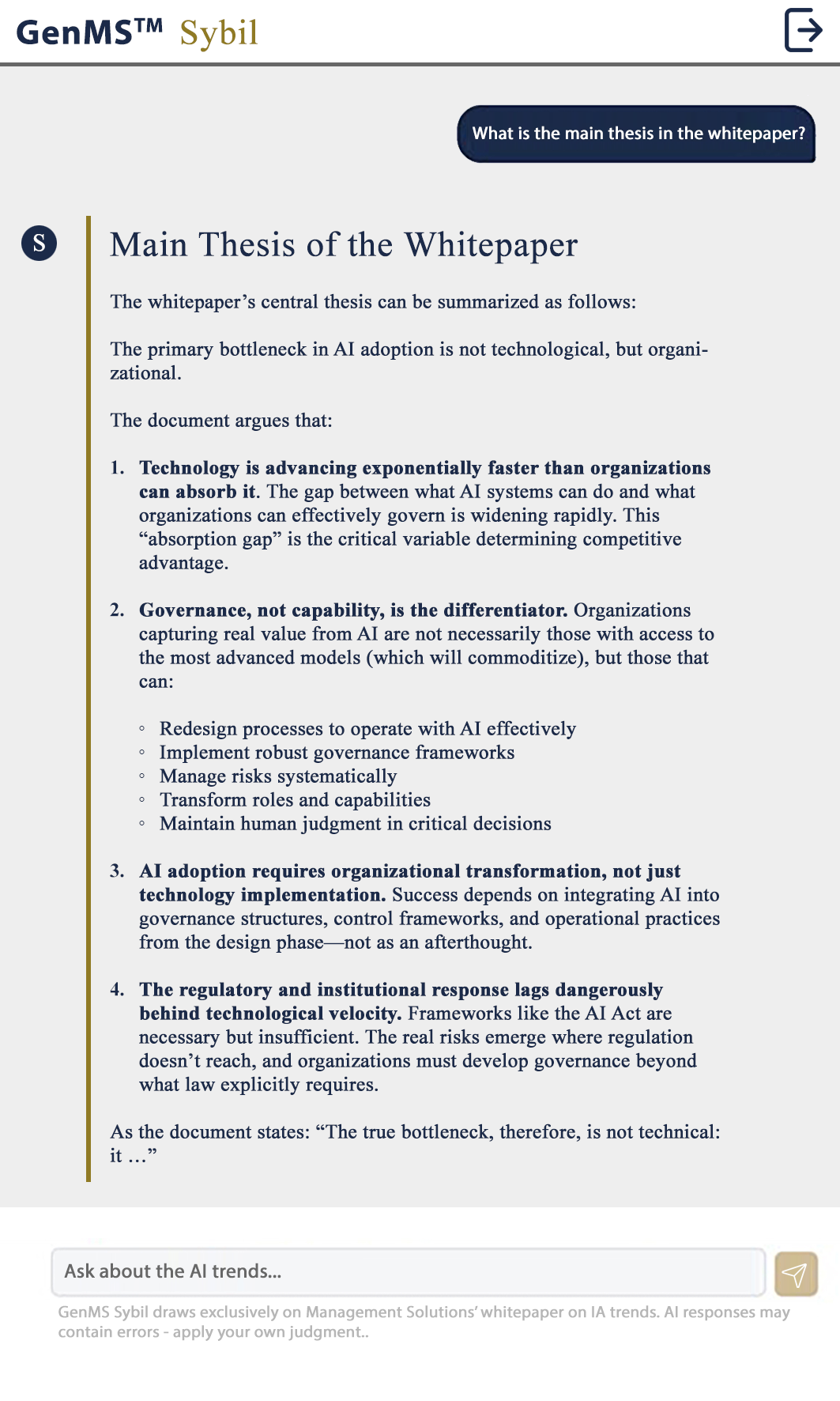
GenMS™ Sybil is a publicly accessible conversational assistant, built on the full content of this document. It answers questions, explores implications and accompanies reflection on the trends discussed here. It does not store users’ personal data and therefore does not present any difficulties with respect to the General Data Protection Regulation. The system is compliant-by-design: regulatory classification, AI Act requirements and privacy obligations were not incorporated as a subsequent layer of compliance, but as design criteria from the first specification phase.
The process: LLMOps lifecycle
The build followed the LLMOps lifecycle phases sequentially and without exception.
Data preparation. The corpus of GenMS™ Sybil is this document. The decision not to extend the system with the full content of cited sources was deliberate: doing so would have introduced copyright and intellectual property risks that are difficult to manage. GenMS™ Sybil is aware of the references, cites and links to them, but does not reproduce their content. Source control and minimization are, here, simultaneously a technical decision and a compliance requirement.
Experimentation and development. This phase produced the complete specification of the system: architecture, expected behavior, taxonomy of use cases, operational limits, quality criteria and security requirements. The specification, dozens of pages long, was built in dialogue with an LLM through vibe coding: the professional formulated objectives, evaluated proposals and made decisions; the machine materialized the intent into production technical documentation. Alternative model configurations were evaluated, prompt versions were managed from the beginning, and qualitative evaluation metrics were defined: coherence, factuality, contextual appropriateness, behavior in the face of out-of-scope questions.
Validation. The evaluation of GenMS™ Sybil integrated human review into the process, semantic stress testing and red-teaming exercises aimed at identifying undesired behavior. Validation was not a one-time event at the end of the process; it was continuous throughout the cycle. GenMS™ Atlas - Management Solutions' system for testing LLM-based systems - evaluated the system on several of its 26 dimensions: bias, consistency, privacy, robustness, explainability and regulatory compliance. Detected issues were addressed prior to deployment; those that persist are documented.
Deployment. The system build was executed by Claude Code from the full specification. The result was a consistent application, with context logic, session management and user interface. The code was audited for vulnerabilities and potential attack vectors, and the corresponding fixes were incorporated within the same development cycle. Deployment took into account the infrastructure, latency and cost implications of a generative system in production from the outset.
Monitoring. GenMS™ Sybil operates with active monitoring of costs per token, full traceability of interactions for auditing and regulatory oversight, and alerts for anomalous behavior or unanticipated usage patterns. The construction process was iterative: the first version was not the final version. Controlled iteration, with explicit evaluation criteria at each cycle, is what distinguishes industrialization from experimentation.
Architectural decisions
The design of GenMS™ Sybil involved concrete technical dilemmas, solved with explicit criteria:
- RAG vs. full context: full context. The underlying model has an input window of one million tokens; the document fits in its entirety in each conversation. RAG fragmentation would destroy the overall coherence that the most valuable questions require, and the cost argument that historically justified it no longer compensates for this deterioration in quality.
- Extension of the corpus with cited sources: discarded. The risk of copyright and intellectual property infringement is incompatible with a public access system. GenMS™ Sybil cites and links references; it does not reproduce their content.
- Fine-tuning vs. prompting: prompting with document in context. Fine-tuning is costly, slow and opaque to document updates. Prompting guarantees full traceability of each behavioral change.
- Proprietary vs. open source model: proprietary frontier model. The maturity of open source models is insufficient to guarantee the consistency and security controls required in a public system without continuous human supervision.
- Persistent memory vs. independent sessions: independent sessions. Data minimization, structural GDPR compliance and elimination of risk of contamination between conversations.
The GenMS™ Sybil system prompt is several pages long. It codifies the behavioral guardrails, the operational limits, the handling of out-of-scope questions and the ethical principles governing system responses. Its contents are not published in full for security reasons. Its length reflects a principle that this document articulates in the ethics section: the gap between the stated values and the actual behavior of an AI system is closed in the specific instructions that govern it, not in the principles that frame it.
Trends in action
GenMS™ Sybil does not illustrate the trends this paper discusses: it implements them. The democratization of generative AI made it possible for profiles without software engineering specialization to produce a production system. Vibe coding was the construction method, not the metaphor. LLMOps structured a process that would otherwise have been unrepeatable. The profiles involved combine business knowledge with the ability to run cognitive systems: the profile that talent analysis identifies as the scarcest and most decisive. AI audited AI at the security phase. GenMS™ Atlas applied systematic validation where ad hoc validation would have been insufficient. Regulation was a design criterion, not a requirement for subsequent compliance.
Table ofcontents

Introduction

Executive Summary

The Technological Explosion of AI



Case Study: GenMS™ Sybil

Conclusions

References & glossary